The Missing Infrastructure Layer for AI Agents
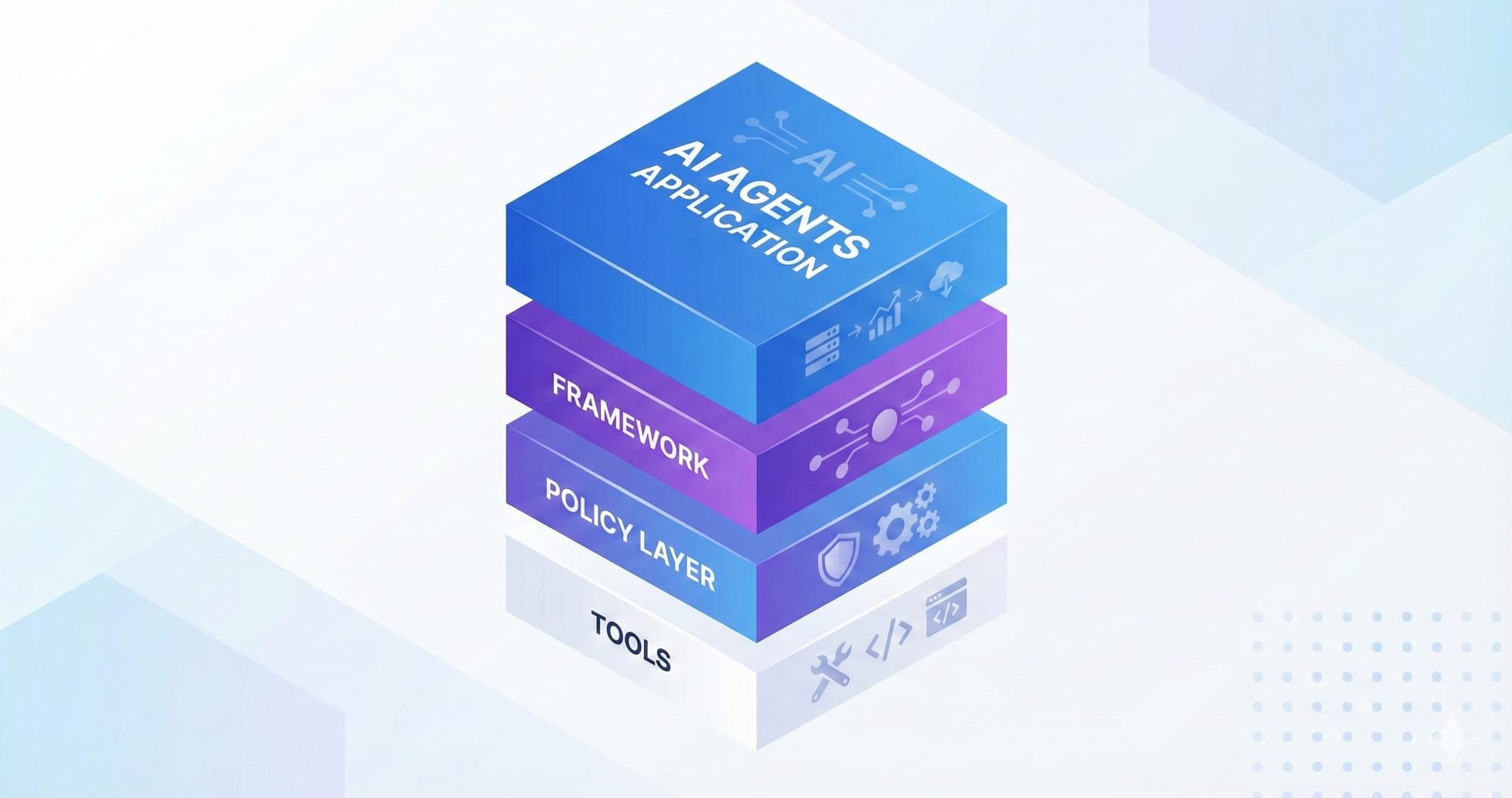
Every technology stack has layers. Web applications have databases, APIs, load balancers, and CDNs. Mobile apps have operating systems, runtime environments, and app stores. Each layer solves a specific problem that every application needs.
The AI agent stack is forming right now. We have models (OpenAI, Anthropic), frameworks (LangChain, LlamaIndex), and observability (LangSmith, Helicone). But there's a critical gap—one that's blocking companies from deploying agents to production.
There's no execution control layer.
The Problem Nobody Is Solving
AI agents are fundamentally different from traditional software. They don't follow deterministic code paths. They reason, make decisions, and take actions based on probabilistic models. This creates a new class of infrastructure problem:
How do you guarantee an autonomous system won't do something catastrophic?
Traditional software has clear guardrails:
- Databases have schemas and constraints
- APIs have rate limits and authentication
- Cloud platforms have IAM and resource quotas
AI agents have... prompts.
"Never run DROP or TRUNCATE against production." "Always verify the customer's identity before issuing refunds." "Only query data from the last 30 days—never access older records."
These aren't guardrails. They're suggestions. And agents ignore them.
Why Current Solutions Don't Work
Companies deploying AI agents today rely on three approaches, and all three fail at scale:
1. Prompt Engineering
The idea: Write detailed system prompts that explain the rules.
The reality: Prompts are interpreted probabilistically. An agent might follow your instructions 95% of the time, but that 5% causes production incidents. Worse, prompts can be bypassed through user input or edge cases the model hasn't seen.
2. LLM Based Guardrails
The idea: Use a second LLM to validate the first LLM's output.
The reality: You've doubled your latency (200-500ms added), doubled your cost, and you're still relying on a probabilistic system to check another probabilistic system. It's turtles all the way down.
3. Human in the Loop
The idea: Require human approval for critical actions.
The reality: You've eliminated the entire value proposition of automation. If a human has to review every decision, why use AI at all?
What's Missing: Deterministic Execution Control
The infrastructure layer that doesn't exist yet is one that sits between agent reasoning and tool execution enforcing policies deterministically before any action is taken.
This layer needs to:
- Validate every agent action against defined policies
- Enforce rules that cannot be bypassed by clever prompting
- Operate at infrastructure speed (<20ms overhead)
- Provide audit trails for compliance and debugging
- Work universally across any LLM, framework, or tool
No one is building this because everyone assumes it's an application layer problem. "Just write better prompts." But that's like saying "Just write better code" instead of building databases with constraints.
Why This Matters Now
AI agents crossed a capability threshold in 2024. They can now do genuinely useful work—generate SQL queries, handle customer support, manage infrastructure, write code. Companies are deploying them.
But every company hits the same wall: "What if it messes up?"
- A SQL agent that crashes your database
- A support agent that issues unauthorized refunds
- A DevOps agent that deploys to production instead of staging
- A coding agent that leaks credentials in generated code
These aren't hypothetical. They're happening. And companies are making the same choice: either accept the risk (most don't) or add human review (which defeats the purpose).
The missing infrastructure layer solves this. It makes the 95% reliable agent into a 100% safe agent—not by making the model perfect, but by making violations impossible.
What This Layer Looks Like
Imagine deploying an AI agent with the same confidence you deploy traditional software:
User asks agent: "What are our best selling products?"
Agent generates: SELECT product_name, SUM(quantity) FROM orders...

→ Policy layer intercepts
→ Validates: "Sales queries require date filters"
→ Detects: Missing WHERE clause with date
→ Auto fixes: Adds WHERE order_date >= CURRENT_DATE - INTERVAL '3 months'
→ Executes corrected query

Total overhead: <1ms
The agent never had the chance to execute a bad query. The policy layer enforced the rule at the infrastructure level.
The Stack of Tomorrow
In five years, every production AI agent will run through an execution control layer. It will be as standard as:
- Authentication for APIs
- Load balancers for web services
- Firewalls for networks
The stack will look like this:
┌─────────────────────────┐
│   Application Layer     │  (Your product)
├─────────────────────────┤
│   Agent Framework       │  (LangChain, LlamaIndex, custom)
├─────────────────────────┤
│   Policy Layer          │  ← The missing piece
├─────────────────────────┤
│   Tool Execution        │  (Database, APIs, services)
├─────────────────────────┤
│   Infrastructure        │  (Cloud, networking)
└─────────────────────────┘
Companies building agents today are either:
- Building this layer themselves (expensive, slow, becomes tech debt)
- Skipping it and accepting risk (can't scale)
- Waiting for someone to build it (losing competitive advantage)
Why We Built Limits
We built Limits because this infrastructure layer needs to exist. Every conversation with teams deploying AI agents revealed the same pattern:
"Our agent works great in testing." "We can't deploy it to production." "One mistake could cost us $50K." "We need guarantees, not best efforts."
Limits is that guarantee. It's the policy enforcement layer that sits at the infrastructure level, validates every agent action in sub-millisecond time, and blocks violations before they execute.
It's not about making AI smarter. It's about making AI safe to use.
A Challenge to Builders
If you're deploying AI agents to production, ask yourself:
- Can you guarantee your agent won't make a catastrophic mistake?
- Do you have an audit trail proving safety controls are enforced?
- Can you demonstrate to regulators that violations are impossible?
If the answer is no, you're not missing better prompts or a smarter model.
You're missing infrastructure.
Limits is building the execution control layer for AI agents. We enforce policies at the infrastructure level with deterministic validation that cannot be bypassed.
If you're deploying agents and need safety guarantees, talk to us: founders@limits.dev